Call Us!
Investigating Catastrophic & Wrongful Death Cases With Medical Toxicologist Dr. Bill Boroughf
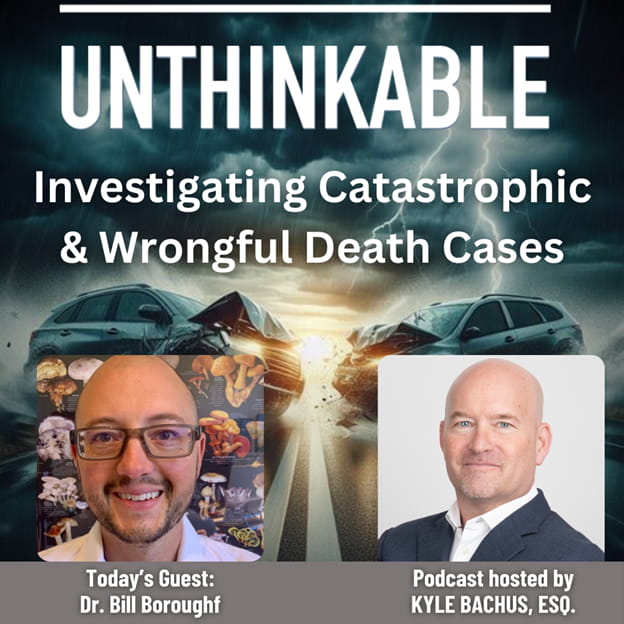
Investigating Catastrophic & Wrongful Death Cases With Dr. Bill Boroughf
In this eye-opening episode of Unthinkable, attorney Kyle Bachus is joined by one of the nation’s few board-certified medical toxicologists, Dr. Bill Boroughf, to unpack the complex intersection of toxicology, public safety, and civil justice.
Dr. Boroughf shares his path from emergency rooms to forensic consulting and explains how toxicologists help uncover truth in wrongful death and catastrophic injury cases. From analyzing blood alcohol content after death to examining the unique challenges of marijuana impairment, Dr. Boroughf breaks down why interpreting toxicology data isn’t as simple as reading a number. With decades of experience consulting on high-stakes overdose, alcohol, and chemical exposure cases—including international work in New Zealand—Dr. Boroughf’s insights reveal the critical need for expertise when the science gets murky
Key Insights:
Medical Toxicology 101: Fewer than 600 toxicologists practice in the U.S.—and their skill set is vital for both emergency response and litigation.
Forensic Toxicology in Court: Postmortem alcohol levels can be misleading due to internal injury, decomposition, or contamination.
Eye Fluid Testing: Vitreous humor offers more accurate postmortem alcohol readings than blood in compromised samples.
Chronic Drinkers at Risk: High tolerance masks impairment—chronic drinkers may seem “fine” but still be dangerously impaired.
Alcohol Myths Debunked: Charts and “gut checks” are unreliable—alcohol impairs judgment, including your judgment of your own impairment.
Driving Impairment Starts Early: Even two drinks can impair driving; the U.S. still allows higher BAC limits than many other countries.
THC and Legal Gaps: Unlike alcohol, marijuana doesn’t show a consistent timeline of impairment, making regulation difficult.
Science Lagging Behind Law: THC legalization happened before science caught up—there’s no clear way to measure real-time marijuana impairment.

FAQ – Toxicology, Alcohol, And Wrongful Death Cases
Who Is Dr. Bill Boroughf?
Dr. Boroughf is a board-certified medical toxicologist with decades of experience in clinical consulting, poison control, research, and civil litigation—including wrongful death cases involving drugs and alcohol.
Why Is Postmortem Alcohol Testing Unreliable?
After death, alcohol can redistribute throughout the body or even be produced by decomposition. Internal injuries can also contaminate blood samples. Toxicologists often use vitreous humor (eye fluid) for more accurate readings.
Can Experienced Drinkers Drive Safely Even With High Bacs?
No. Chronic alcohol use can mask external signs of intoxication but does not eliminate cognitive or motor impairment. These individuals are still dangerous on the road.
How Does THC Differ From Alcohol In Testing?
THC is fat-soluble and metabolized slowly and irregularly. Unlike alcohol, there’s no direct correlation between the amount detected and a person’s current level of impairment.
Why Does The U.S. Still Use A 0.08% DUI limit?
Despite research showing that impairment begins at lower levels, the U.S. has been slow to lower its legal limit. Only Utah has adopted the more conservative 0.05% standard used in many other countries.
What Role Does A Toxicologist Play In Civil Cases?
They interpret medical records, autopsy data, and toxicology reports to determine how substances may have contributed to injury or death—often clarifying or challenging initial assumptions.
Subscribe to our podcast